
The 2026 Best Real Touch Calla Lilies Buying Guide begins with a practical question: what makes an artificial bloom look genuinely alive? Real Touch Calla Lilies should offer softly curved petals, a natural matte finish, and stems that hold their shape without appearing rigid. The best designs also show subtle color movement, from creamy white edges to gentle green shading near the throat. They should look convincing under daylight, not only in carefully edited product photos.
Market evidence supports careful purchasing. The USDA National Agricultural Statistics Service reported approximately $6.7 billion in U.S. floriculture crop sales for 2023, showing the continuing importance of professional flower production and presentation. The National Retail Federation also recorded about $2.6 billion in U.S. flower spending for Valentine’s Day in 2024. These figures describe fresh flowers, not artificial stems, but they reveal strong consumer expectations for floral realism, quality, and emotional value. Artificial-flower market reports from Grand View Research similarly identify home décor, event styling, and long-lasting arrangements as major demand areas.
Details matter more than dramatic claims. Check petal thickness, stem flexibility, base stability, color consistency, and UV-resistance information. A close-up image may hide rough seams or plastic-looking centers. Touch the petals if possible. Smell does not prove quality. Nor does a high price guarantee realism. This guide compares materials, craftsmanship, maintenance needs, and seller reliability for 2026 purchases. It also acknowledges an imperfect truth: no artificial calla lily can fully reproduce a living flower’s movement, scent, or changing texture. The goal is not perfection. It is believable beauty that remains attractive beside real foliage, across seasons, and in ordinary home lighting.
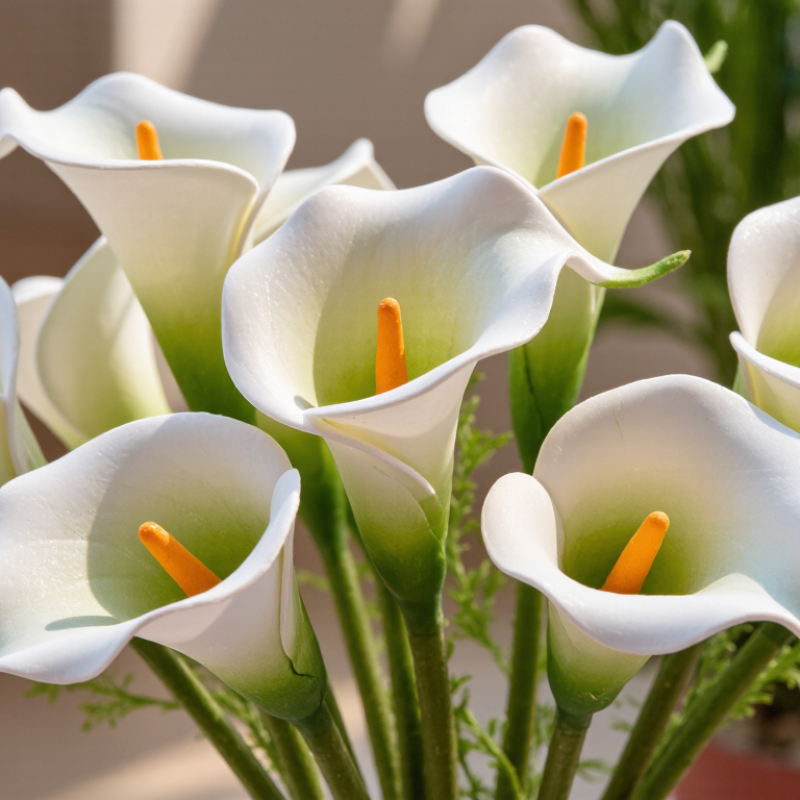
Real-touch calla lilies are designed to imitate the soft surface of a fresh flower. Their petals commonly use polyurethane, latex, or flexible TPE coatings over a shaped core. Material quality varies widely. Some petals feel silky, while others feel slightly rubbery after prolonged storage.
The form matters as much as the material. A convincing calla lily has a gently rolled trumpet, a natural crease, and a visible spadix inside the bloom. The stem should bend slightly without looking weak. Leaves often include subtle veins and uneven green tones. Perfect symmetry can look artificial. I prefer small color shifts and mild curling at the edges.
These flowers work well in wedding arrangements, entryway displays, restaurant tables, and low-light rooms. They need no watering, but dust can collect inside the trumpet. A soft brush helps. Keep them away from strong heat, direct sunlight, and rough surfaces. I have found that cheaper petals may flatten in a crowded box. Warm air can sometimes reshape them, but excessive heat may damage the finish. No material is perfect. Check the texture, seam quality, stem flexibility, and care instructions before buying.
For a real-touch calla lily, petal material matters more than a glossy photograph suggests. I compare PU, latex, and silicone by feel, edge behavior, and light response. The useful range is usually 0.8–1.2 mm. A digital caliper helps, although curved petals can distort readings. I measure three areas, not one. Thin samples can feel elegant. They can also crease too easily.
PU PU petals around 0.8–1.0 mm feel light and flexible, with a smooth, slightly dry surface. They suit arrangements that need gentle movement.
Latex Latex near 0.9–1.1 mm often feels warmer and more elastic, but its texture may become too rubbery under strong pressure.
Silicone Silicone at 1.0–1.2 mm usually gives the most convincing soft drag against the fingers. It also holds a curved trumpet shape better, though extra weight can bend a narrow stem.
Texture deserves close inspection. Press the inner petal with a clean fingertip, then release it slowly. A realistic surface should recover without looking sharply molded. Check the rim, where weak finishing becomes obvious. Look at the flower under side lighting. Good translucency should fade gradually, not appear as a flat plastic shine.
Specifications can be imperfect. Thickness may vary across one petal, and “real touch” can describe different formulas. Ask for close-up images and measured samples before buying.
I still trust handling evidence more than attractive wording.
2026 Best Real Touch Calla Lilies Buying Guide
Stem length changes the entire visual balance of a calla lily arrangement. For compact table pieces, choose 30–40 cm stems. They sit neatly in bud vases and leave room for candles or place cards. A 40–50 cm stem suits medium ceramic vases and small entry displays. Use 50–60 cm stems for tall floor arrangements, ceremony backdrops, or dramatic reception corners.
The USDA’s 2023 Floriculture Crops Summary reported about 8,100 U.S. growing operations and $6.7 billion in wholesale floriculture sales. That scale suggests strong demand, but it does not guarantee consistent artificial stem sizing. Measure the full stem, not only the flower head. Some real touch calla lilies include flexible wire, which can reduce usable height after bending. I once planned a 45 cm vase with 40 cm stems. The flowers looked crowded.
For weddings, event planners should match stem height with viewing distance. The Knot’s 2024 Real Weddings Study reported average floral and decor spending of about $2,800. That budget deserves careful proportion. Choose 30–40 cm stems for guest tables, where low sightlines matter. Select 50–60 cm stems for stage areas, where flowers must read from a distance. Check leaf placement, stem firmness, and color under venue lighting. Shorter may look richer. Taller is not always better.
Match 30–60 cm calla lily stems with a vase that is approximately two-thirds of the stem length. This proportion provides stable support while keeping the flower heads visually elevated for bouquets, centerpieces, and event arrangements.
Planning guide: Short 30 cm stems suit compact bouquets and small vases, while 50–60 cm stems are better for tall vases, formal arrangements, and larger event displays. Vase heights are calculated at two-thirds of the selected stem length and rounded to the nearest centimeter.
2026 Best Real Touch Calla Lilies Buying Guide
Real touch calla lilies should feel soft, slightly waxy, and naturally cool. I test the stem before judging the flower head. A reliable stem usually uses 18–22 AWG wire, offering strength without looking bulky. Bend it gently. It should hold a curve, but not crack or spring back sharply. Thin stems often collapse inside tall vases. Heavy stems may look stiff and artificial. I once accepted a beautiful sample with weak wiring. It failed after one arrangement.
Colorfastness needs a simple home check. Rub a hidden petal area with a slightly damp white cloth. Little or no color should transfer. Check the edges, folds, and green throat carefully. Uneven dye can become obvious under warm indoor lighting. Also place one stem near a bright window for several days. Compare it with an unexposed stem. This test is imperfect, but it reveals fading better than photographs.
Tips: Ask for close-up photos of the stem, petal texture, and leaf veins. Test one sample before buying multiple pieces. For outdoor displays, confirm UV resistance through product specifications or testing records. UV-resistant material can still fade under intense sun. Rotate arrangements when possible. Store unused flowers away from heat and direct light. A small quality check prevents a disappointing bouquet.
For 2026, buying real touch calla lilies requires more than checking how realistic the petals look. Lifespan should be judged by the coating, stem construction, and exposure conditions. A soft latex finish may feel natural, but sunlight, heat, and frequent handling can cause fading or surface cracking. Ask for care instructions and realistic durability estimates. “Long-lasting” is not a useful measurement alone.
Safety documentation deserves equal attention. Check whether the materials have been tested by an independent laboratory. Relevant reports may cover restricted chemicals, surface coatings, dyes, and flame behavior, depending on your market and intended use. A reliable seller should identify the tested material and report date. Certificates with no laboratory details deserve caution. Look closely.
Total cost includes more than the displayed price. Add delivery, protective packaging, replacement stems, cleaning supplies, and storage space. For a wedding display, calculate the cost per use. For home décor, compare expected service years instead. I once underestimated shipping because several stems required separate packaging. That mistake changed the cheaper option completely.
Inspect close-up photos for uneven petal edges, loose wires, and sticky surfaces. A mild material smell may fade, but a strong odor should prompt questions. Keep invoices and product specifications for later reference. My judgment is imperfect: appearance can still outweigh durability during a short event. Yet a lower price is rarely economical when the lilies need replacing after one season.